
How Britain’s fascist leader enabled child sex abuse at the highest level in his post war organisation
It’s December, 1963, and Britain’s fascist leader Sir Oswald Mosley is hosting his annual Xmas dinner at an Italian restaurant in east London. Gathered together are various Blackshirt luminaries and stalwarts of the movement. Amongst them is Alf Flockhart, a lifelong fascist and right hand man to Mosley. Flockhart is accompanied by a 15 year-old-boy, to whom he is not related. It is not the first time they have attended Mosleyite gatherings together. But Flockhart is a convicted, violent child sex offender who has been gaoled twice for his offending. Mosley knows this, as do others attending, and yet not a single word of protest is raised by any of those present.
Lawrence Alfred Lockhart, known to his comrades as Alf, joined the pre-war British Union of Fascists in 1936 as a boy of only 16 and quickly rose to become its youngest district leader, in Shoreditch. In 1940, he was convicted after shaking a collecting tin at a Bethnal Green BUF street meeting and shouting: “Help to make a Jewish pogrom. And put a nail in the Jewish coffin”. Unsurprisingly, he was amongst the thousand or so Blackshirts rounded up under Defence Regulation 18B at the outbreak of war.
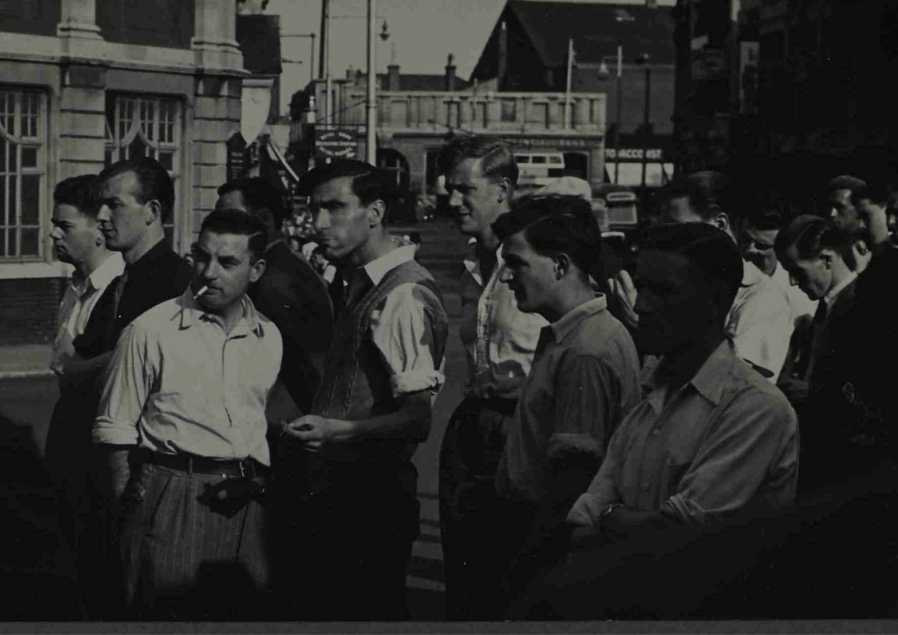
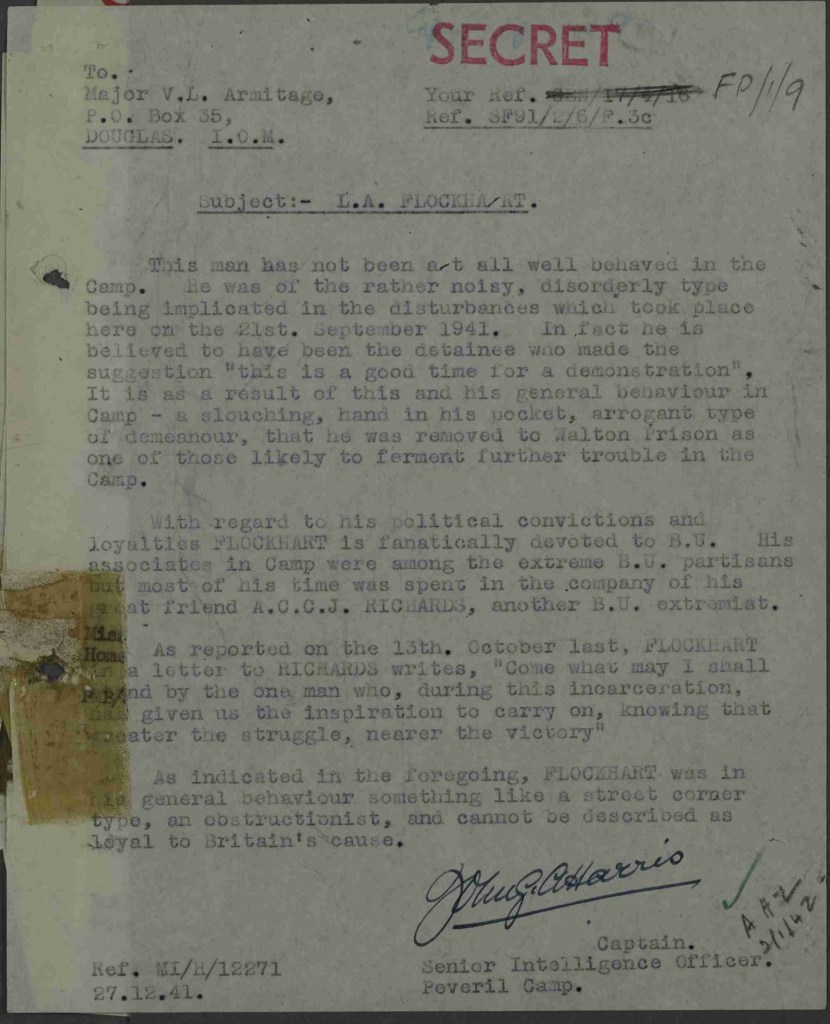
MI5 and Special Branch files covering his subsequent detention record that he remained a passionate fascist. Held at Peel Camp, on the Isle of Man, Flockhart, and the BUF group he associated with, were described as the most extreme and fanatical fascists detained. He was one of a five man BUF “cabinet” who commanded the Blackshirt contingent in the camp, and Flockhart himself was a “house leader”. Security reports describe him as a “rather noisy, disorderly type” who was suspected of having instigated a riot at the camp in 1942, after “whipping up anti-Jewish hate” at a Boxing Night party and then organising a “Jew hunt” in the camp, seeking out Jews who had been held under the Defence Regulations merely because they were of German nationality.
Appearing several times before a review committee which could decide to release him, he routinely lied: he was not anti-Jewish; if released he would now join the Conservative Party; he wanted to sign up in the armed forces and fight for his country. The first lie was undermined by his letters to friends and comrades which were regularly signed off with “PJ” which in the fascist lexicon stood for “Perish Judah”. Flockhart told the committee it actually stood for “People’s Justice”. The last lie was exposed by one such letter where he wrote to a friend that if released he would just register as a conscientious objector.
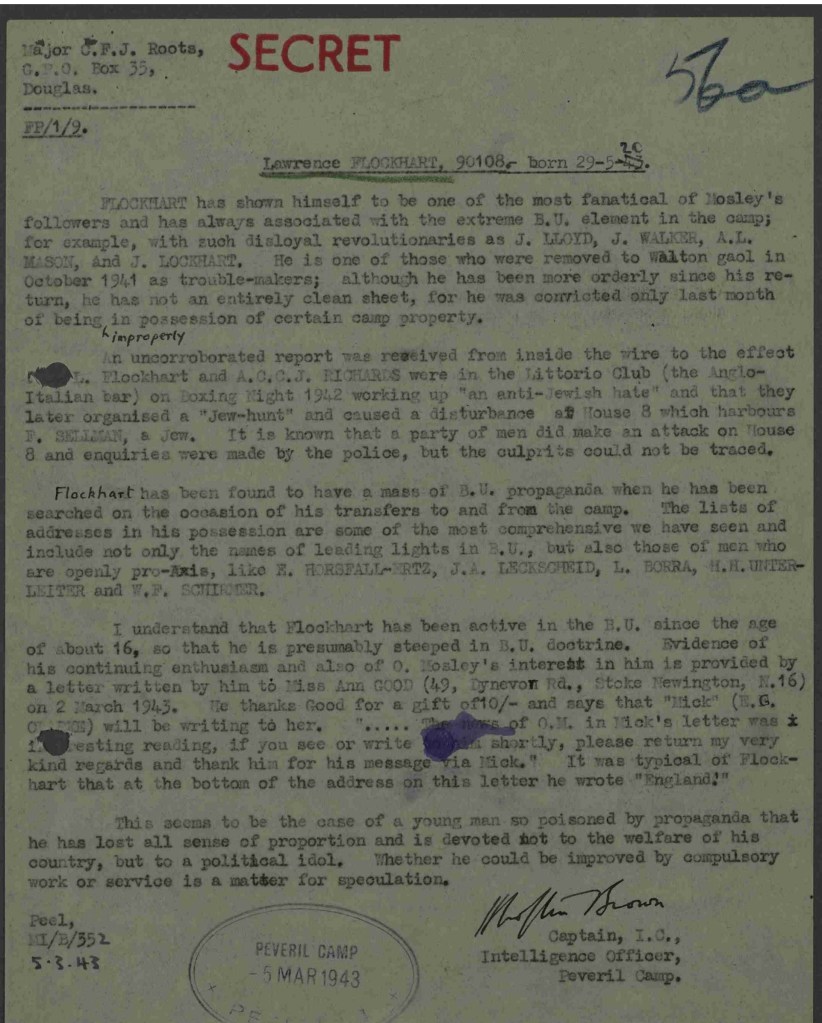
One telling comment in these files concerned his teenage involvement with the Boys’ Brigade and the Leysian Mission, a charitable Methodist institution providing social and sporting activities to deprived children. The Boys’ Brigade was based in the Mission’s Shoreditch premisses. At one point the 18B review committee asked the Mission for their impression of him. The Mission secretary wrote back that Flockhart had caused them certain anxieties, “on account of his undesirable activities among younger boys…”
After the war Flockhart quickly became a central part of Mosley’s attempts to rebuild the fascist movement and in June 1945 he was one of the core group invited to Mosley’s flat in Dolphin Square, London, and his country house at Crux Easton, in Hampshire to discuss plans for the future. Flockhart was heavily involved in the first major post-war Mosleyite initiative, the 18B Detainees Aid Fund Committee which, as he and others later revealed to supporters, was set up with the “dual purpose” of helping former detainees and gathering funds for election campaigns.
When Mosley launched Union Movement in 1948 and set up headquarters in Vauxhall Bridge Road, in Victoria, Flockhart was employed as a full-time organiser with living quarters on the premisses. He was a bruiser frequently involved in street confrontations with political opponents but one of his other functions, which drew comment even in Union Movement, was as organiser of the Drum Corps, comprised mainly of teenage boys, and known amongst the membership as Flockhart’s “Bum Corps”.
There was much salacious gossip about goings on in the HQ basement on drum crops practice nights, Trevor Grundy, whose parents were close to the Mosley leadership, and who wrote the fascinating “Memoir of a Fascist Childhood” told Searchlight “with absolute certainty”, that although he was not abused himself, he knew that Flockhart “terrorised” other young members of Union Movement in their teens or early twenties. But whatever was known or suspected about his behaviour, no-one in the leadership did anything to investigate or stop it.
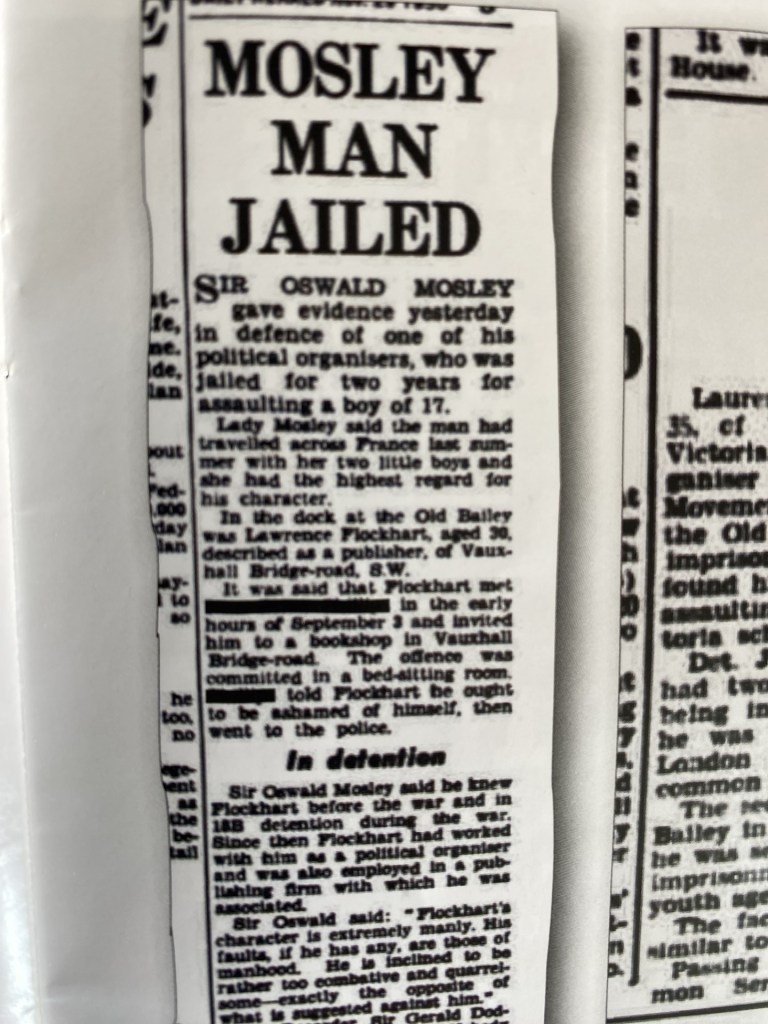
Then, in 1950, Flockhart was arrested. He picked up a 17-year-old boy who had missed the last train home from Victoria Station and offered to let him stay the night in his flat in Union Movement HQ. Once in the flat, Flockhart attacked him and tried to rape him. He was arrested and charged with assault with intent to commit buggery. At trial, Mosley gave evidence on his behalf. He did not believe the allegations, he said, and told the court that:
“Flockhart’s character is extremely manly. His faults, if he has any, are those of manhood. He is inclined to be rather too combative and quarrelsome – exactly the opposite of what is being suggested against him”.
Lady Mosley also pitched in, telling the court that:
“I have left him with my children on many occasions. Last Summer he travelled across France with the two boys for me. I have the highest regard for his character.”
The court, however, was not quite so gullible. Flockhart was convicted and gaoled for two years.
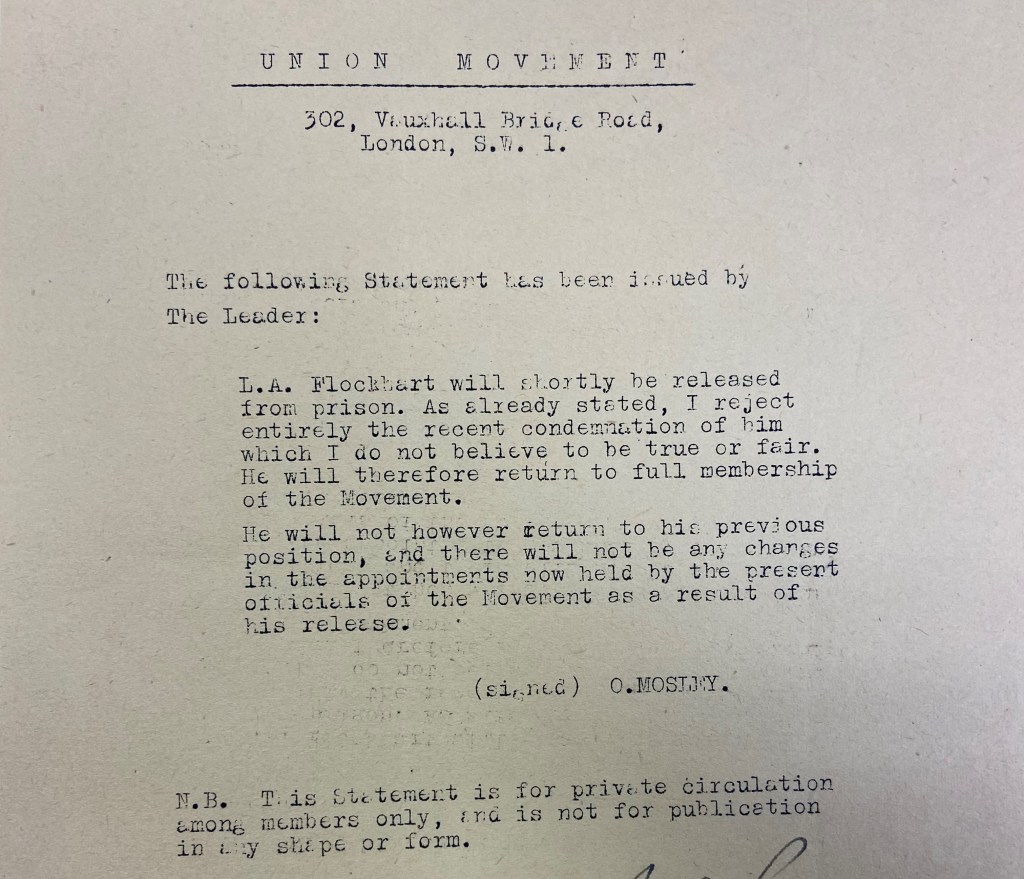
But Mosley was having none of it. Even after the conviction he stood by his man: in February 1952, shortly before Flockhart was due to be released, Mosley sent a confidential circular to movement organisers informing them that:
“L A Flockhart will shortly be released from prison. As already stated, I reject entirely the recent condemnation of him which I do not believe to be true or fair. He will therefore return to full membership of the movement…”
This didn’t go down well with some of the members, particularly in the east end, so a more gradual approach was adopted. When Flockhart was released Mosley paid for him to go on holiday to the country. Then, a month later, a discreet party was held to welcome him back into the fold.
Although he did not return to his former positions, the regard in which Mosley held him was indicated by the fact he was put in charge of arranging for the children of leading, surviving German nazis to come and study in England. Amongst those welcomed by Flockhart were Waltraud Skorzeny, the daughter of Otto Skorzeny, and the sons of Heinrich Himmler and Joachim von Ribbentrop.
When Flockhart was later appointed Central and East London organiser, however, there were resignations in protest but still Mosley was determined to rehabilitate his man. At the 1954 Union Movement conference Flockhart received a special award for outstanding services to the movement. Then, in 1955, when UM’s national secretary Alexander Raven Thomson died, Flockhart succeeded him, taking over the administration of the movement and afforded a free hand by Mosley to run it as he saw fit. Flockhart was also charged with looking after relationships with foreign fascists and fascist groups.
His rehabilitation was now complete, and he went on to play a crucial role in shifting Union Movement policy away from an obsession with anti-Semitism to a focus on immigration and crude anti-black agitation, a policy which contributed to modest electoral successes in Flockhart’s old east end stamping grounds.
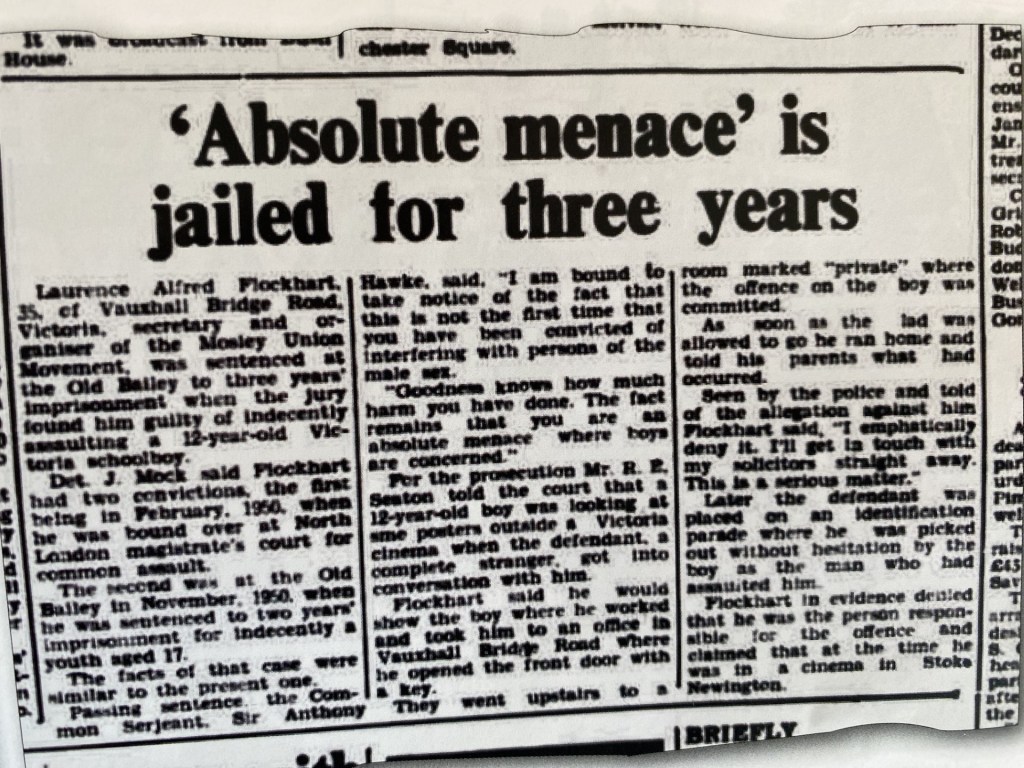
Then, in 1956, he was arrested again, and this time it was even more serious. The charge was indecent assault. Again, it had happened in Union Movement headquarters. This time his victim was a 12 year-old-boy whom Flockhart had picked up outside a cinema and persuaded to go back with him to the headquarters flat. Once there, Flockhart had sexually assaulted him. Flockhart again denied it but now even Lady Mosley had to concede. “He was obviously guilty,” she said. “We have finished with him. It would only happen again”. This time, Flockhart, sentenced to three years in prison and described by the judge as “an absolute menace”, was expelled from Union Movement.
Trevor Grundy, whose youthful involvement in Union Movement ended in the early 1960s, told Searchlight that Robert Row, editor of the UM paper Action, put it about amongst the members that Flockhart had been convicted of “interfering” with a man in a public toilet and that he had been “framed by the Jews”. Most likely not realising the true gravity of the offence, Grundy’s mother corresponded with Flockhart during his imprisonment. She was probably the only one. On his release Flockhart visited the Grundy home on several occasions.
And there it should have ended. Mosley, prepared to give his loyal follower the benefit of the doubt the first time round, could now have no doubt that Alf Flockhart was a violent, predatory child sex offender who should have no place in Union Movement. According to Trevor Grundy, east end members of Union Movement threatened to resign en masse if Alf Flockhart was ever seen again at headquarters or allowed to re-join the organisation. So, the parting should have been for good.
But that’s not what happened.
In 2022, I had cause to re-establish contact with a Searchlight informant who had operated in the far right with great courage and at considerable personal cost many years ago. He had long since dropped out, but I contacted him in relation to another project. When we met he told me, for the first time, how he had come to be involved in the extreme right in the first place: how, in 1962, aged only 14 and sitting alone in a London coffee bar, he had been approached and befriended by Alf Flockhart.
Our informant, whom I shall call Malcolm, was already aware that he was gay and was an easy target for Flockhart who groomed and abused him over the next two years. When they first met, Flockhart was not obviously involved in politics, but browsing the bookshelves of Flockhart’s Notting Hill flat, Malcom found books signed and personally dedicated to Flockhart from the likes of Otto Skorzeny, Hans-Ulrich Rudel and Juan Peron. Then, several months after they met, Flockhart started taking him to Mosleyite events.
So, what had happened? The truth is that even after the second conviction, Mosley never truly disowned Flockhart. Shortly after his release he was welcomed by Mosley at his Cheyne Walk apartment, although Lady Mosley insisted he only be allowed into the kitchen. Mosley also helped him with work, arranging a job for him at what was then the Sir Henry Lunn Travel company.
Then, in July 1963, faced with attacks and disruption from the anti-fascist 62 Group and others, Mosley recalled the old street fighter and organiser to co-ordinate Union Movement’s physical response to the opposition with the help of another former Blackshirt bruiser, the Smithfield meat porter, Danny Harmston. The two of them also acted as Mosley’s bodyguards.
In pretty short order, Flockhart was back at the heart of things: not just organisationally, but socially as well, invited to Lady Mosley’s soirees and other select leadership gatherings. And at many of these events, Flockhart was accompanied by Malcolm, still only 15-years-old, who was introduced to an array of celebrity supporters of Mosley. Lady Mosley’s memory was obviously very short ideed. It plainly was “happening again” and the Mosleys were clearly not “finished with him” at all.
Malcolm recalls that at the 1963 Xmas dinner, for instance, were the writer Henry Williamson (of “Tarka the Otter” fame), the Irish woman racing driver and former 18B detainee Fay Taylour, and Commandant Mary Allen, the former women’s police commander who had gone from suffragette to dyed-in-the -Blackshirt. At the head of the table, of course, were Oswald and Lady Mosley. But, as Malcolm himself now observes: “They knew all about Flockhart at this point. And yet nobody was asking “What on earth is he doing here with a 15-year-old boy?’” Flockhart was pursuing his abusive behaviour in plain sight of the Union Movement leadership, and nobody was lifting a finger.
In the official history of the British Union of Fascists, “We marched with Mosley”, Richard Reynell Bellamy wrote that: “If there was one stain from which British fascism was free, it was sexual vice”. He could not have been more wrong, and the suspicion is that he must have known it. Why else would someone as prominent in the BUF as Flockhart merit not a single mention in its official history? For the truth is that Lawrence ‘Alf’ Flockhart, one of the movement’s most senior officers, both before and after the war, was a violent, predatory child sex abuser, and Oswald Mosley, the movement’s founder and leader, at first refused to believe it, then forgave it, and then enabled it.
It is the great untold scandal of the Mosleyite movement.
This article first appeared in Searchlight, Spring 2022

 andy bell
Leave a comment