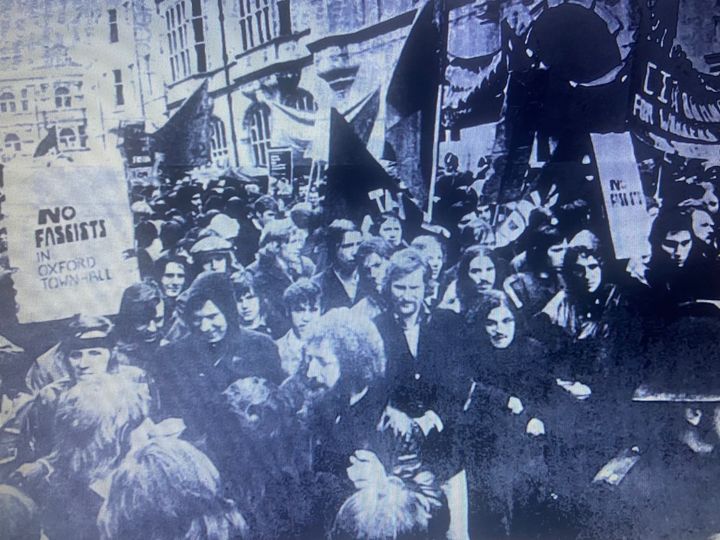
On May 12, back in 1975, over 1,000 people blockaded the Town Hall in Oxford to try to prevent the National Front holding a public meeting during the European Referendum campaign. It was a significant event for a number of reasons.
The demonstration had been called by the Oxford Anti-Fascist Committee (OAFC), set up in late 1974 in response to the events at Red Lion Square, where an anti-fascist, Kevin Gately was killed by the police during an anti-National Front demonstration, and to the burgeoning presence of the NF in certain parts of the country.
It was one of many local anti-fascist groups which sprang up at the time.
In Oxford, the initial impulse came from the International Marxist Group (IMG) but was quickly supported by the International Socialists (IS – now SWP) the Communist Party (CP) and libertarian groups. And it was the role of the Communist Party in particular that made it significant.
There was the potential to build not just mass opposition to the NF meeting, but also a unified mass campaign to try and stop it taking place
OAFC was a delegate body and the support of the CP – with its considerable presence in the local labour movement – delivered important trade union support. And, throughout, the Committee’s leadership was largely trade union based – its Chairman, from the IMG, was Tony Homer who worked in the local car factory and its secretary, Tony Kitchener, from the CP, was a print worker.
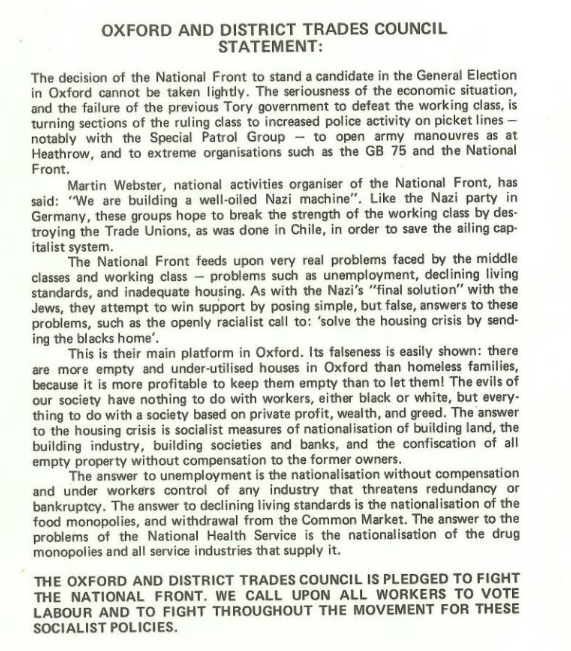
Other local trade union branches sent representatives and were joined by delegates from student groups, the women’s movement, ward Labour Parties and the University Gay Group. Even the Young Liberal signed up.
Soon after its creation, OAFC disrupted two National Front meetings during the October 1974 General Election, one in a local school, the other in the Town Hall. Both times the venues were occupied by anti-fascists who held their own meetings instead.
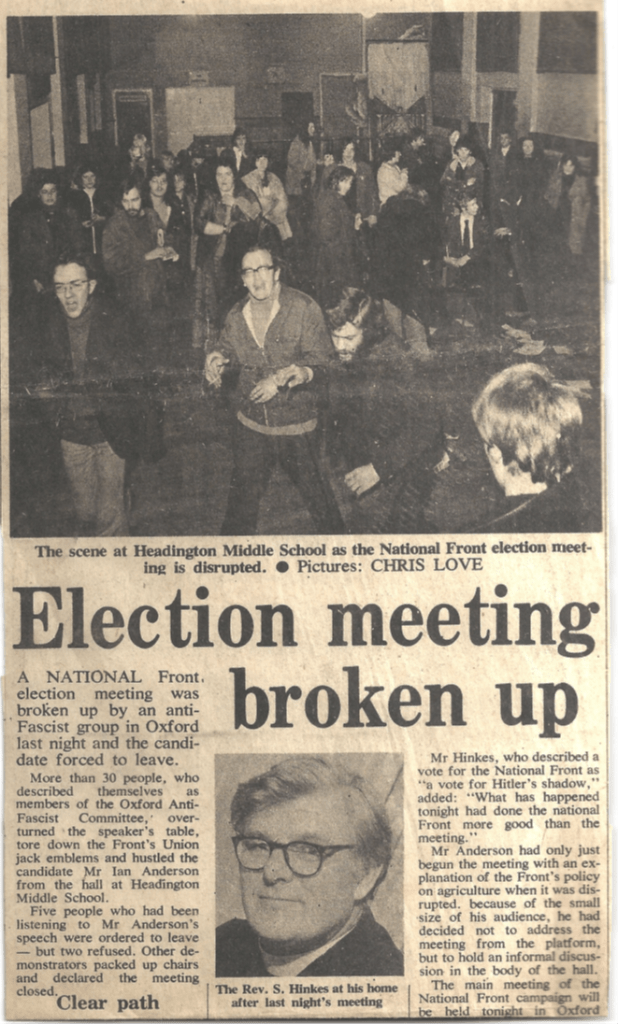
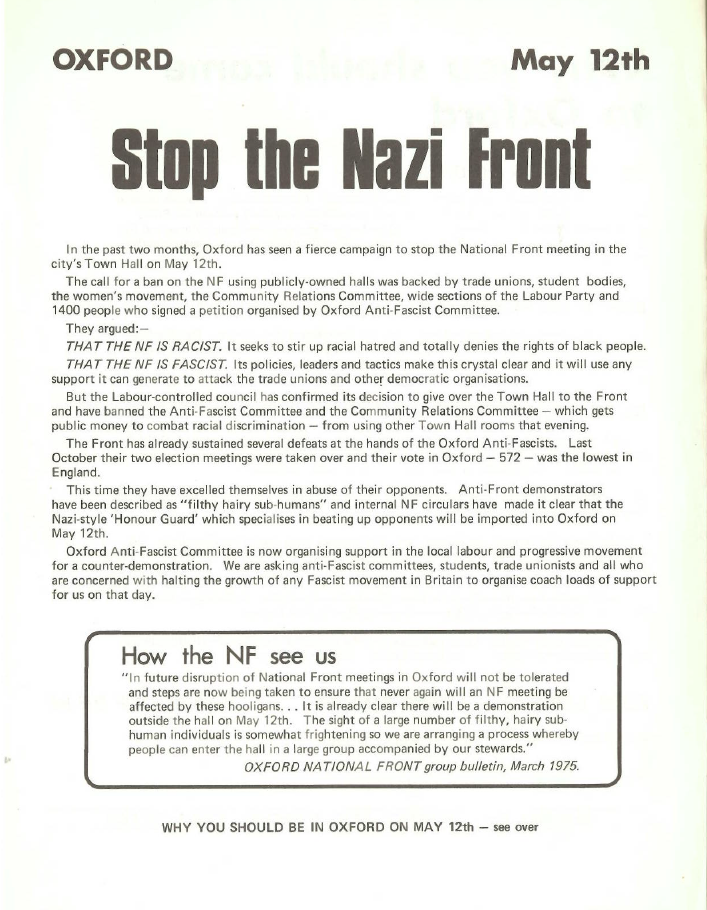
It was humiliating for the local NF who ended up polling their lowest vote in England. When they announced the 1975 meeting in the Town Hall they also told their members that their “Honour Guard” of thugs would make sure that this time it went ahead.
So, the stakes were high.
The “No Platform” debate raging at the time in the NUS and the events at Red Lion Square had exposed sharp differences within the anti-fascist movement. On one hand were those like the IMG and IS who supported “No platform” unequivocally and wanted to implement it. On the other were those, like the Communist Party, who were a bit more nervous.
‘Counter-hegemonic’ alliances
Although the CP students supported No Platform in the NUS debate of 1974, some in the party leadership feared it would alienate their trade union support.
Others favoured building “counter-hegemonic” alliances through non-confrontational tactics such as silent vigils and peaceful demonstrations. The party leadership also saw the struggle against fascism as merely part of the overall struggle against racism.
Oxford District CP however, adopted a robust view which set them at loggerheads with their national leadership. They took the issue of prioritising anti-fascist work to the party congress that year and won major concessions. And, with one or two nuanced qualifications, they staunchly supported the policy of No Platform.
Stop it taking place
This meant that with the right political preparation, there was the potential to build not just mass opposition to the NF meeting, but also a unified mass campaign to try and stop it taking place.
On the other arm I was linked with Val McDermid, sporting a crash helmet with a pink triangle on it, also giving her all
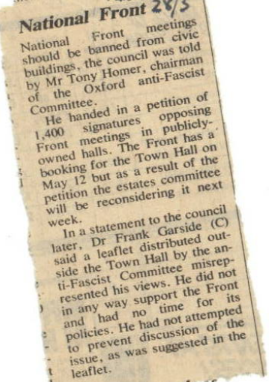
And that is what happened. The Labour council was lobbied to cancel the meeting backed up by a petition bearing over 1400 names. But they refused to budge. They pleaded free speech. We argued it didn’t apply to fascists.
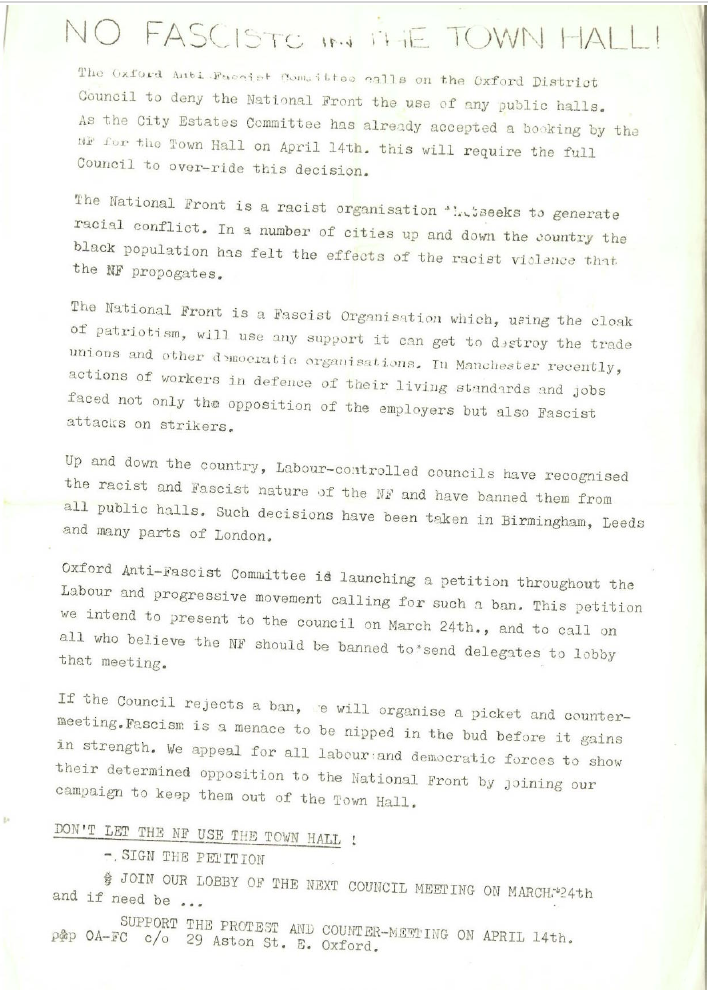
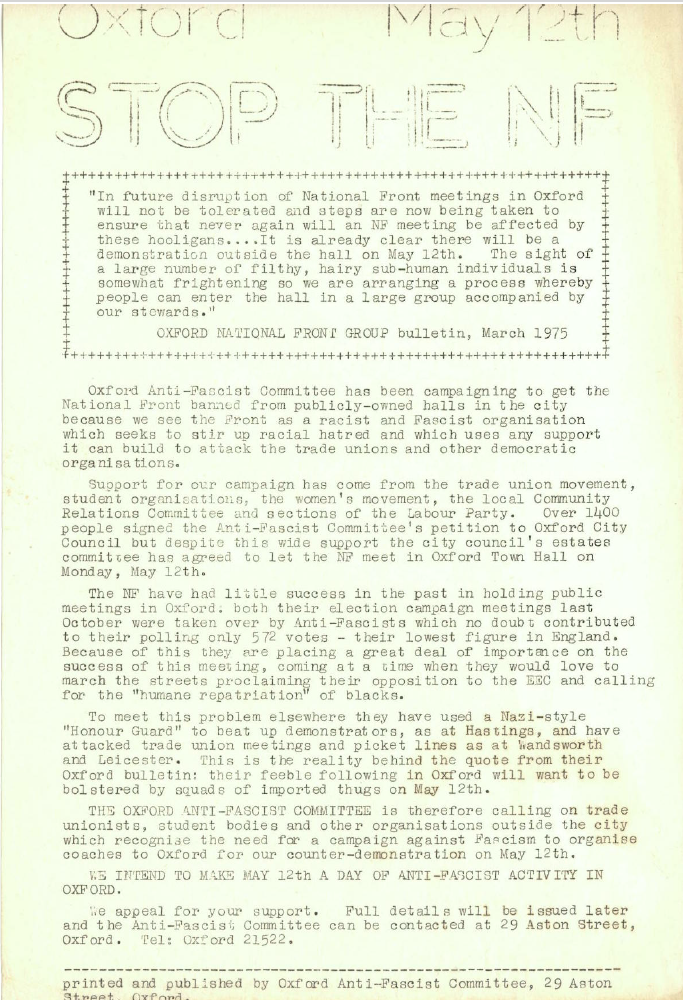
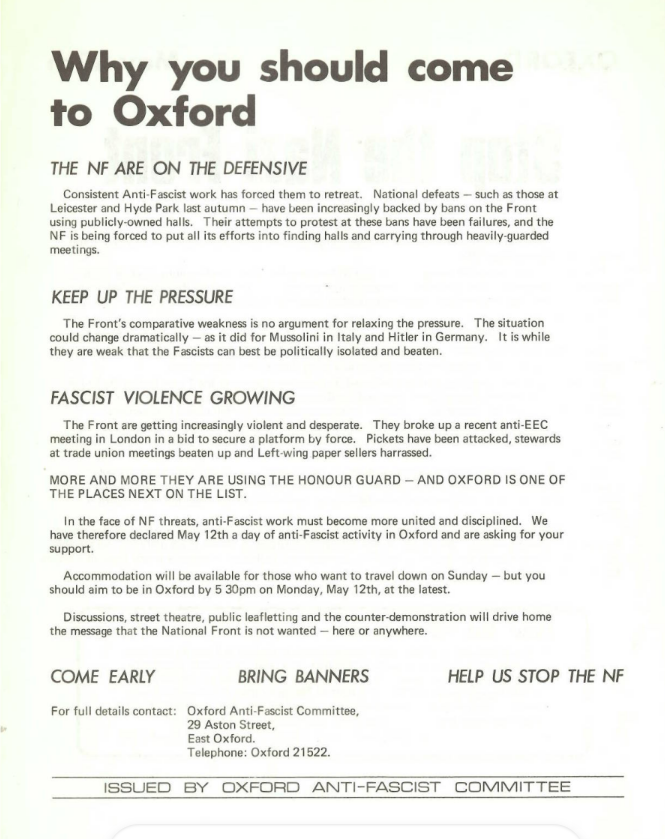
12 May saw a day of anti-fascist activities across the city but in the evening there was no soft option. No silent vigil. No protest march half a mile away. If you were opposed to the NF event you joined the mass picket at the Town Hall to try to stop it.
The real significance
And this was its real significance: I think it was the first time in the growing campaign of opposition to the NF that a mass action was called with the declared intention of stopping a Front event happening.
In contrast to previous guerrilla type actions carried out by handfuls of activists, on 12 May more than 1,000 people turned out to blockade Oxford Town Hall.
Pressure on the police lines to get in and occupy the Town Hall failed, but I still have an abiding memory of being arms linked with an American Jewish friend of mine, one of the gentlest souls you can imagine, giving it his all to break through.
On the other arm I was linked with Val McDermid, now of course a famous crime novelist but then the OAFC delegate from the university Gay Group, sporting a crash helmet with a pink triangle on it, also giving her all. Many years later even Tony Blair claimed to have been there.
The NF members responsible were quickly located drinking in a nearby pub and only saved from serious retaliation by the timely arrival of a police car
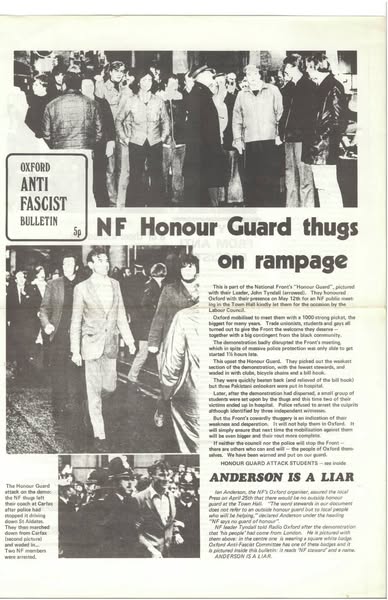
The NF did bring in their “Honour Guard”, armed thugs bussed in from London, who attacked the demonstration from behind and eventually forced their way into the Town Hall after some fierce fighting.
I ended up clutching an iron hook that one of them left behind which I handed over to a police officer pretty sharpish. They also attacked members of the Pakistani Welfare Association who had brought a sizeable contingent to the picket.
Counted it a victory
The NF meeting did take place – but over an hour later than planned and with only the Honour Guard sitting in the audience. We counted that as a victory.
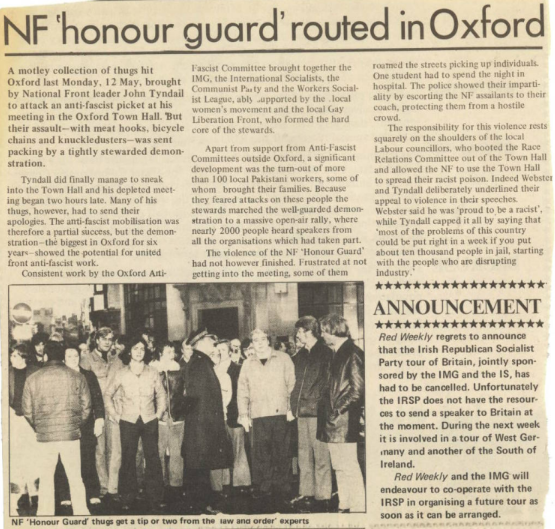
The other victory, of course, was winning such mass support for a policy of trying physically to stop it going ahead.
There was an aftermath: following the meeting, some of their thugs attacked two student anti-fascists outside their college, kicking them unconscious. One was hospitalised.
Both of them, Neil Whitehead and Paul Tajfel, are sadly no longer with us, but both are seen in the front line of the picket in the top photo.
Serious retaliation
The NF members responsible were quickly located drinking in a nearby pub and only saved from serious retaliation by the timely arrival of a police car.
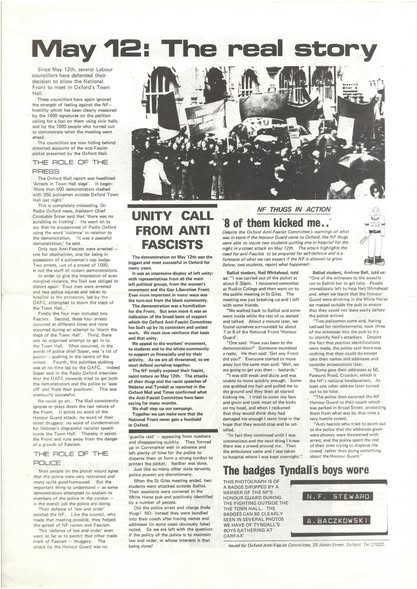
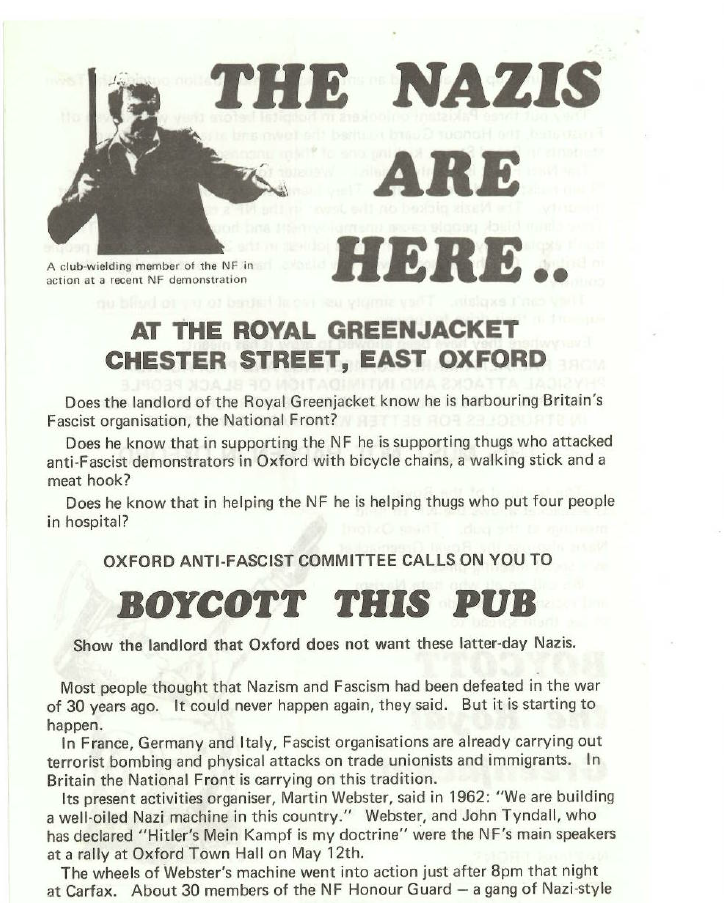
But there was some come-uppance a few days later. A small group of anti-fascists went to picket a local pub, the Royal Green Jackets, where the NF branch was due to meet and began chatting with the police officers who inevitably turned up.
The police remarked that they had been particularly angered by the sight of NF members leaning out of the Town Hall windows inciting us to attack the police lines. “Oh look, here he comes now” said one officer as the local NF organiser, Ian Anderson, came down the street with one of his chums.
And with that, all the police officers turned their backs and looked the other way. The hint was duly taken and a few seconds later, after a brief exchange of views, Anderson and his mate were left dazed and bruised on the pavement.
Remarkable record
Oxford Anti-Fascist Committee dissolved itself into the ANL in 1977 but in the three years of its existence it had a remarkable record of confronting fascism and denying it a presence in the city.
The NF never even managed to hold a weekend paper sale without it being brought to an abrupt halt and their literature confiscated.
The Committee’s success, though, was built on a rare unanimity on the question of how to fight fascism; a unanimity that was achieved in no small part because the local Communist Party went up against its national leadership.
The result was a genuine and hugely successful united front against the fascists.

 andy bell
Leave a comment