
Thirty years on, the inside story of how Searchlight and ITV’s World In Action exposed the activities of a violent neo-nazi terror group in Britain.
Thirty years ago last month Granada Television’s ‘World In Action’, then one of the premier investigative programmes in the country, broadcast the first film I made as a newly made up producer. It was no real surprise to anyone that it was about the extreme-right.
At the time I had a foot in both the WIA camp and that of Searchlight, the anti-fascist magazine for which I had worked, in my spare time, since 1975. I had edited the magazine for several years in the late 1980s, although I had ceased contributing when I joined WIA.
Gerry Gable, Searchlight’s founder and editor, and I were agreed that Combat 18, which had embarked on a campaign of physical assaults, death threats and arson attacks, needed to be exposed and that a WIA film was the ideal vehicle. Not only could it bring to the task investigative resources that Searchlight simply did not have but it also guaranteed to put the story before millions of viewers.
Gerry had two informants working inside Combat 18. Both were young, former fascists who, for their different reasons, had seen the light and offered to work for Searchlight. One of them was Tim Hepple, who was running with the BNP. The other was Matthew Collins of the National Front.
Tim was already coming under suspicion and his future as an informant was limited. So, he agreed that he would appear in the programme, telling what he knew and then retire from the work. The assessment, which turned out to be right, was that he would face little in the way of retribution.
With Matthew it was a little more complicated. He worked at the London headquarters of the National Front where he picked up and passed on much valuable information. And, as yet, he had not come under suspicion at all.
There was a reason for that: Matthew hung around in particular with Eddie Whicker, a senior NF member, but also a leader of Combat 18 and a member of the London branch of the Ulster Defence Association (UDA). This connection gave Matthew not only protection, but unique insight into goings on at a leadership level in Combat 18, without actually being involved in it.
We were using a former Flying Squad surveillance officer to watch both [Sargent] and Whicker to nail down their movements.
Matthew agreed to help us, but in the film, ‘The Terror Squad’, his testimony was delivered anonymously and by an actor. We took every care and more to ensure that there was nothing in it which might point the finger at him, and Matthew crawled over every word in the actor’s script to satisfy himself not just that it was accurate, but that it would not cause him difficulty.
The film catalogued death threats, beatings, violent assaults and arson attacks which had been carried out by C18. It revealed hitlists, contained in a bulletin called Redwatch, distributed to C18 members with instructions to harass and attack people whose names and addresses appeared in it. It revealed the help C18 had received from notorious American Nazi leader, Harold Covington, one of the organizers of the infamous Greensboro massacre in 1979, when anti-Klan marchers were shot dead by Nazi and Klan gunmen. He provided a US post office box address to keep C18 correspondence secure
The film’s climax was two dramatic doorstep confrontations between me and the main C18 leaders identified in the programme, Charlie Sargent and Eddie Whicker. Planning these had been meticulous because we knew it would be touch and go whether we could confront both of them.
Sargent, a convicted drug dealer, and known to carry a knife, lived with his girlfriend in a council flat in Camberwell, south London. We were using a former Flying Squad surveillance officer to watch both him and Whicker to nail down their movements. If we were to doorstep both, we had get to the second before he was warned by the first.
“…bullet in your head, that’s what’s going to happen”
Whicker, the dustman, followed a pretty regular pattern: out in the early hours of the morning, back indoors at lunchtime. But our surveillance chap was astonished to see how he left home and drove to work. “Is he counter-surveillance trained?” he asked after watching Whicker drive through red lights, turn into one way streets, and perform sudden u-turns in the empty early morning streets of Thornton Heath.
In the end, we just had to risk it. Our crew staked out Sargent first, giving ourselves an entire morning to confront him, and then get to Thornton Heath before Whicker got home from his early shift and went indoors to find, we anticipated, a message on his answering machine from Sargent warning him that WIA were out and about.
Come late morning, we had almost given up hope of seeing him and were about to cut our losses and move to Thornton Heath. Then we got a walkie-talkie message from our ex-cop, secreted on another landing of the block of flats. “He’s on the move”. When Sargent exited the council estate I was waiting for him with our crew. And it didn’t take long for Charlie to kick off.
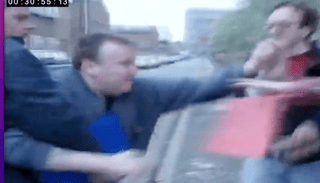
Within seconds he had launched himself at the camera, only to be pushed away by two very competent close quarter personal bodyguards who had been hired for the occasion. One, looking for all the world like a note taker, was in fact carrying a stab proof clipboard. I put blunt questions to Sargent: “Tell us about Redwatch, your C18 hitlist. Why does it carry an American address? Tell us about your relationship with the UDA”. It all happened on the move and lasted several minutes, passing across the precincts of Camberwell Magistrates Court. In the end, Sargent had had enough. He stopped and turned to me: “Yeah, tell you what’s going to happen” he snarled, “bullet in your head, that’s what’s going to happen”. He shaped his fingers into a gun and pointed directly at my head.
Whicker behaved a little differently. He told Matthew later that when our van pulled up alongside as he was parking his car, and people started jumping out of the side door, he genuinely thought the Provisional IRA had come for him. But he recovered his composure and, after initially telling me to “piss off out of it…” he got out of his car, stood on the pavement and tried to argue it out. The questions to him were directed entirely at his connection with the UDA. At first he denied it, then answered “no comment” to several questions. But that approach dropped him right in it when I said “The UDA kills Catholics. Do you support that?” Whicker replied “There’s no comment on that…” which was both the end of the interview and a wonderfully clear insight into the mind of Eddie Whicker.
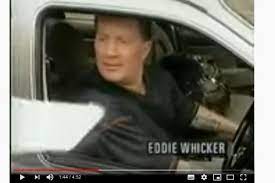
The following weekend he turned up at a BNP anti-IRA march where he was feted like a hero. “Eddie, you were magnificent” said BNP leader John Tyndall, shaking his hand warmly. But for all the bravado on screen, Whicker was a worried man. He phoned Matthew: “Too much trouble, for fuck’s sake…I don’t need this.”
Unfortunately, it was not long before Matthew came under suspicion and when it became clear he might be in serious danger Searchlight arranged for him to go to Australia, his ticket paid for, money in his pocket, and a job and accommodation waiting for him. He was to stay there for ten years before it was considered safe for him to return. He was safe, but it was a very high price for a young man to have to pay for merely doing the right thing.
I confess that, at the time, I thought little of Sargent’s threat to me. However, five years later when we were making a second WIA film about Combat 18, centred on Sargent’s trial, conviction and life sentence for the murder of one of his fellow C18 members, we discovered there had been a very real and advanced plot to kill Quentin McDermott, one of the other journalists who had worked on ‘The Terror Squad’. It was only abandoned when Sargent and others were arrested on race relations charges.
That second film, Playing With Fire, described the plot against Quentin but also revealed how the security services had been allowing C18 to run unhindered, in return for information that Sargent was able to give them about the activities of the UDA and other loyalist extremists in Northern Ireland.
For anyone interested, both films are here:

 andy bell
Leave a comment